MITHANDIR
Workshop management system for heavy machinery: the whole shop from a computer or a phone
Custom workshop software: a machinery workshop of about 10 people runs from a computer or a phone with Claude, from quotes to cash. 131 invoices in one prompt.

- OwnerQuote for Sample Town: motor grader service Claude
crear_presupuestoQ-0412 · PDF ready - Owner · from the phoneWhich quotes are still unanswered? Claude
listar_presupuestos4 awaiting reply - OwnerQ-0412 was approved. Open the job. Claude
abrir_trabajoJob 0613 open - OwnerSchedule it Thursday with Mechanic A. Claude
planificarThu · Mechanic A - Owner · from the phoneMechanic A logged 6 h on job 0613. Claude
cargar_parte6 h · with its cost - Owner · from the phoneAdd the hydraulic filter from this invoice. Claude
agregar_repuesto_a_trabajoFilter → job 0613 - OwnerInvoice job 0613 with B 0001-00000412. Claude
facturar_trabajoB 0001-00000412 - OwnerThey paid by bank transfer. Claude
registrar_cobroPaid · Bank - Owner · from the phoneHow are the cash accounts? Claude
ver_cajas3 accounts · up to date - OwnerWho owes us money? Claude
cuentas_por_cobrar3 customers · PDF
- Quotes Q-0412 · PDF ready
- Follow-up 4 awaiting reply
- Jobs Job 0613 open
- Schedule Thu · Mechanic A
- Job logs 6 h · with its cost
- Parts Filter → job 0613
- Invoices B 0001-00000412
- Payments Paid · Bank
- Cash 3 accounts · up to date
- Who owes 3 customers · PDF
- 01 / 04The owner writes to Claude, from the computer or from his phone.
- 02 / 04Claude picks the tool, shows what it will enter and enters it once he says yes.
- 03 / 04Quotes, jobs, invoices, payments and cash: one message and done.
- 04 / 04A computer or a phone, and a Claude subscription: the whole workshop.
The case on video, explained.
Go to the questions ↓
A workshop of about 10 people, from a computer or a phone
A road machinery service, repair and sales workshop in Funes, Argentina, ran everything in six cross-linked spreadsheets only the owner knew how to read together. We built it a custom workshop management system and gave it a door for Claude. Today the owner runs the whole shop with messages, from his computer or his phone: quotes and their follow-up, jobs, scheduling, job logs, parts, invoices, payments, cash and who owes. With the Claude subscription he already had, and no other software. And data entry and invoicing can be automated too.
- 1 message
- for everything that happens at the shop
- 92 tools
- within Claude's reach, none delete
- 0 extra licenses
- it runs on the owner's Claude subscription
A workshop as usual and this workshop, side by side
The difference isn't the people or the machines: it's the same crew. It's where the shop lives. In one, in six spreadsheets and the owner's head. In the other, in a system you talk to. In the first one, every question goes through the owner and a spreadsheet. In the second, anyone with permission asks, and the answer is already in the system: which quotes are waiting, what's in the till, who owes and since when.
- Before: search the spreadsheetand remember which one had what
- Now: askfrom a computer or a phone, on a Claude subscription
- The same crewabout 10 people, with nobody added to enter data
 Generated image Generated image
- Where the shop lives
- Six cross-linked spreadsheets
- One system, in the cloud
- How often data is entered
- Up to five
- Once
- How it's run
- Opening spreadsheets and copying
- By prompting Claude
- To know who owes
- Cross-check invoicing with payments
- Ask
- The people
- About 10 people
- The same 10 people
Six spreadsheets and the same data entered five times
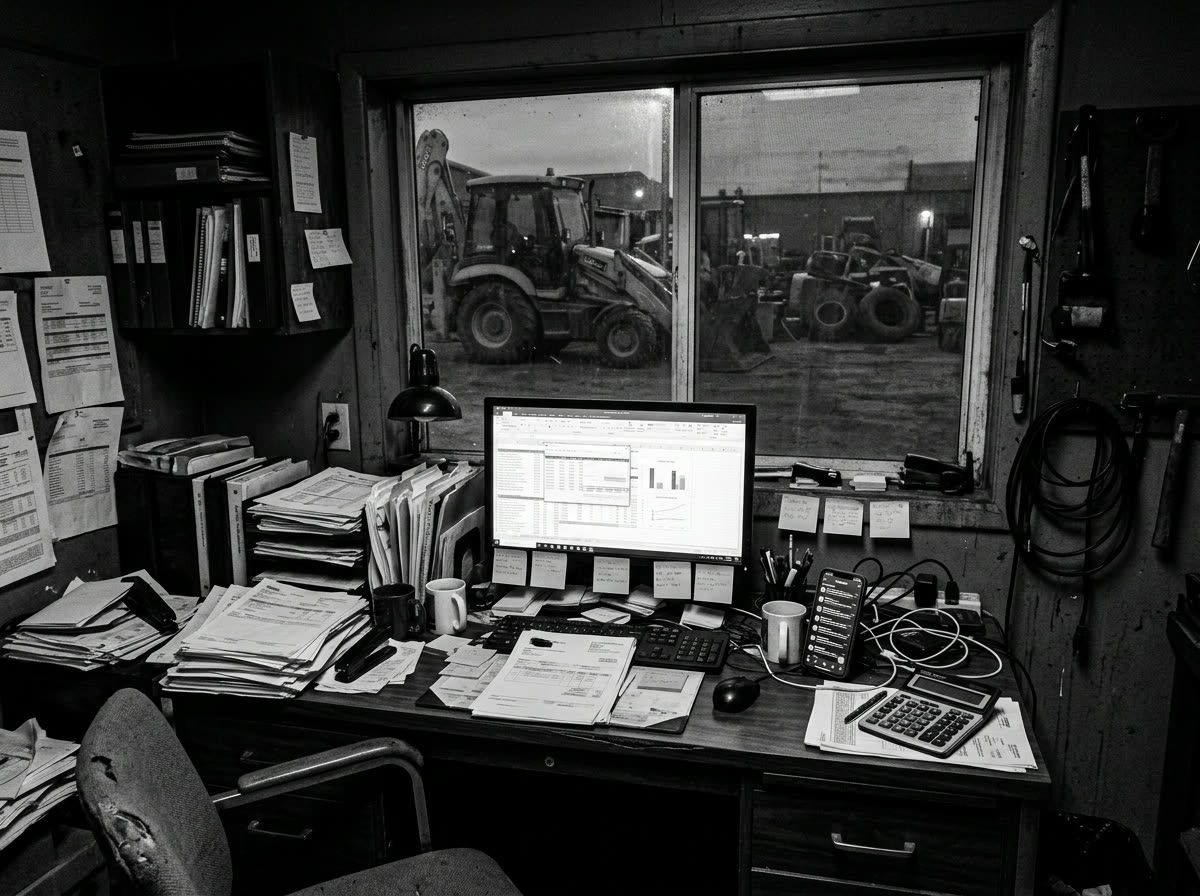
When a job came in, the owner wrote it down. Then wrote it again in the schedule, again in the mechanic's hours, again in invoicing and again in customer follow-up. The same customer showed up under its trade name, its acronym and its legal name, and on paper they were three different customers. Simple questions, like which quotes were still unanswered, how much was in the till or who owed money, meant cross-checking two or three spreadsheets. And the only person who knew how was the owner.
- Can you send me a quote for
the motor grader service? - Approved. When can you see it?
- XLSScheduleweek 43
- 6 h on the motor grader today.
Changed the filter. - Photo · Hydraulic filter invoice
- XLSInvoicing 2026Payments
- 7:40 · Text Build the quote in Excel and export a PDF
- 8:15 · Text Write the job into the jobs spreadsheet
- 8:30 · Spreadsheet Write it again in the schedule, with the mechanic
- 12:10 · Text Copy the hours into the payroll spreadsheet
- 15:20 · Photo Enter the expense and remember which job it's for
- 18:30 · Spreadsheet Cross-check two spreadsheets to see who owes
One job, entered in five places. And only the owner knew how to read them together.
Following up on quotes, with one question
Every quote has a status: draft, prepared, sent, in negotiation, approved, rejected with its reason, or expired. Knowing which ones were unanswered used to mean going through WhatsApp and the spreadsheet. Now the owner asks Claude “which quotes are still unanswered?” and the waiting ones show up, with how many days they've been waiting. When a customer approves, one message is enough: the quote moves to approved and opens the job, with the customer's rules inside. If it's rejected, the reason is kept, so you know why quotes are lost.
- OwnerWhich quotes are still unanswered? Claude4 awaiting reply. The oldest, 21 days ago.
- OwnerThe Town approved Q-0412. Open the job. ClaudeApproved. Job 0613 is open.
- P-0413 West Aggregates
- P-0409 East Quarry 21 d ago
- P-0411 South Waste Co. 6 d ago
- P-0414 Central Roads 2 d ago
- P-0412 Sample Town 3 d ago
- P-0410 North Municipality
Cash and bank accounts, also by message
The owner sees every cash and bank account balance with one question. To move money from petty cash to the bank, or log an expense, he writes what happened. And when the bank statement arrives, he asks Claude to reconcile it: entries already there get checked off, and missing ones, like a bank fee, get created. Cash isn't a loose number: payments come in straight from the invoices, supplier payments go out from theirs, and every collection call is logged, with what the customer said and when to call back.
- Petty cash $ 220.000
- Bank · checking $ 3.380.000
- USD cash US$ 2.400
- Transfer · Sample Townreconciled
- Payment · Southern Partsreconciled
- Deposit · petty cashreconciled
- Bank feecreated
- OwnerMove $ 200,000 from petty cash to the bank.
- OwnerReconcile the bank's October statement.
Everything that runs on a message
A job's whole cycle fits in ten messages, from quote to who owes. And so does the rest of the shop: each mechanic's weekly payroll, the income statement, which jobs made the most money, which machines are due for service and how the day is going. What Claude generates, like a quote or an account statement, comes back to the chat as a PDF ready to send. And all of the shop's data entry and invoicing can also be automated: job logs, expenses, supplier invoices and invoicing come into the system on their own, and the owner only reviews.
- Weekly payrollhourly plus allowance, daily rate or percentage
- Results and profitabilityreal and fiscal, and which job made the most
- Hour-meter maintenancewhich services are due and when
- Automated data entry and invoicingjob logs, expenses and invoices that come in on their own
- Daily summarywho's on what, what's pending, what's due
- 01“Put together a quote for Sample Town for the motor grader service.”
- 02“Which quotes are still unanswered?”
- 03“Q-0412 was approved. Open the job.”
- 04“Schedule it Thursday with Mechanic A.”
- 05“Mechanic A logged 6 hours on job 0613.”
- 06“Add the hydraulic filter from the Southern Parts invoice.”
- 07“Invoice job 0613 with B 0001-00000412.”
- 08“They paid by bank transfer.”
- 09“How are the cash accounts?”
- 10“Who owes us money?”
Claude sees what each person sees, no more and no less
The connector isn't a master key. Claude signs in as whoever is using it, with the same permissions they have on the web. The owner has everything; the foreman handles jobs, scheduling and job logs, but doesn't invoice or collect; the mechanic logs his day and nothing else. Everything entered is logged with who and when.
The 92 tools, split by role: 62 enter data and 30 look things up.
What changed at the shop
The owner stopped copying data between spreadsheets: he writes what happened and Claude enters it, once he says yes. Questions that used to mean cross-checking spreadsheets, like which quotes are unanswered, what's in the till or who owes, are answered by asking. And the same workshop of about 10 people runs from a computer or a phone, with a Claude subscription and no other software.
Quotes and their follow-up, job, schedule, job log, part, invoice, payment, cash and who owes, from the same conversation.
The same data used to be entered up to five times. Now it's entered once.
On October 14, in the same batch: 28 jobs corrected and 80 historical ones.
Whatever he was missing, he asked for from the chat. October 8 to 22.
62 enter data and 30 look things up. None delete, and each respects the role of whoever uses it.
From spreadsheets to Claude, in two stretches
In August 2026 the system replaced the spreadsheets, with the history migrated: whatever couldn't be tied with certainty was kept apart, because an hour assigned to the wrong job ruins that job's margin forever. On October 6 the Claude connector went live, and the next day the owner was already using it. In his first days he rebuilt the shop's invoicing history from the chat: by October 16, 277 invoices had their tax authority receipt attached. Since October 15 he runs the day-to-day from Claude. Whenever something was missing, he asked for it in the same conversation.
- Rev. 01 · 17 aug 2026 The six spreadsheets, migrated with their history →356 work orders and 72 customers where there were 83 ways of writing them.
- Rev. 02 · 18 aug 2026 Three years of scheduling, inside →2,457 slots, from May 2023 to August 2026.
- Rev. 03 · 6 oct 2026 Claude gets into the system →With each user's permissions. No tool deletes anything.
- Rev. 04 · 10 oct 2026 The owner rebuilds the history from the chat →In two days: 175 supplier invoices, 171 customer invoices and 133 suppliers.
- Rev. 05 · 14 oct 2026 One prompt, one whole batch →131 invoices, 28 jobs corrected and 80 historical jobs.
- Rev. 06 · 22 oct 2026 41 owner requests, all 41 resolved →New tools and data fixes, requested from the same chat.
Under the hood: a custom system and a Claude subscription
The system is built with Next.js and Supabase and deployed on Vercel, designed for several workshops from the ground up: this is the first, not the only one. The Claude connector uses the same login as the web, so it respects the same permissions, and the business logic is one and the same for the web and for Claude. There's no other program for the shop to buy: Claude runs on the subscription the owner already has, on his computer or his phone. Every request takes the same path, shown here.
- The owner writes As he'd say it to someone at the shop.
- Claude picks One of the system's 92 tools.
- Shows what it'll enter Customer, machine, job: all in view.
- The owner says yes Without a yes, nothing goes in.
- It's on record In the system, with who and when.
Answer and we’ll tell you if this works for your company.
We review it quickly. If it’s a fit, we set up a meeting.
Five questions about how your workshop runs today. At the end we'll tell you, straight, whether a system like this fits.
Your workshop looks a lot like this case
Pick a time and in 30 minutes we'll look at your real spreadsheets and tell you what can be unified first.

Looking for open times…
Alfonso already has your answers and will write to set a time.
We couldn't save your answers. Send them over WhatsApp and we'll reply all the same:
Send on WhatsAppThere's room to get organized
We'll write within 24 h with two or three concrete ideas for your workshop. Or message us on WhatsApp now.
We couldn't save your answers. Send them over WhatsApp and we'll reply all the same:
Send on WhatsAppThanks for telling us
It may not be the right time yet. Here are other cases showing how we work.
We couldn't save your answers. Send them over WhatsApp and we'll reply all the same:
Send on WhatsAppWork out how many hours a week your workshop spends re-entering the same job. Eight questions, one minute.
Those hours can be won back
Pick a time. In 30 minutes we'll look at your real spreadsheets and show you which of those entries disappear first.
Looking for open times…
Alfonso already has your answers and will write to set a time.
We couldn't save your answers. Send them over WhatsApp and we'll reply all the same:
Send on WhatsAppYou've got your number
We'll write within 24 h with how that number would drop at your workshop. Or message us on WhatsApp now.
We couldn't save your answers. Send them over WhatsApp and we'll reply all the same:
Send on WhatsAppThanks for running the numbers
With these numbers, a custom system may not pay off yet. Here are other cases for when it does.
We couldn't save your answers. Send them over WhatsApp and we'll reply all the same:
Send on WhatsAppRather talk now? Message us on WhatsApp